

Shopify and Amazon are two popular platforms for online selling. They serve different purposes and offer unique features.
Understanding the differences between Shopify and Amazon can help you choose the right platform. Shopify allows you to create your own online store, giving you full control over branding and customer experience. On the other hand, Amazon is a massive marketplace where you can list your products alongside millions of others, benefiting from its huge audience.
Knowing these distinctions is essential for making an informed decision about where to sell your products. This blog will explore the key differences between Shopify and Amazon, helping you understand which platform best suits your business needs.
Business Models
The business models of Shopify and Amazon are quite different. Shopify focuses on empowering individual merchants to build their own online stores. Amazon, on the other hand, operates as a massive online marketplace where multiple sellers list their products. Understanding these differences can help you choose the right platform for your needs.
Shopify’s Approach
Shopify provides a platform for merchants to create their own branded online stores. Here, you are in control of your website’s design, customer data, and branding. With Shopify, you have the flexibility to:
- Choose from various customizable themes
- Utilize a wide range of apps for added functionality
- Integrate with multiple payment gateways
Shopify emphasizes individual business growth. You manage your marketing, customer service, and inventory. This approach gives you complete control over your e-commerce operations.
Amazon’s Strategy
Amazon’s strategy is different. It operates as a centralized marketplace. Here, multiple sellers can list their products. This model offers:
- Access to Amazon’s vast customer base
- Fulfillment services through FBA (Fulfillment by Amazon)
- Trust and credibility of the Amazon brand
Amazon focuses on convenience and scale. You benefit from its established infrastructure and customer trust. Yet, you compete with other sellers for visibility and sales.
Both platforms offer unique benefits. Your choice depends on your business goals and needs.
Ease Of Use
Understanding the ease of use between Shopify and Amazon is essential for choosing the right platform. Each platform offers unique features and interfaces. This section will explore how user-friendly Shopify and Amazon are.
Shopify’s User Experience
Shopify is known for its simple and clean interface. It is designed to help beginners create online stores easily. The dashboard provides an intuitive layout with clear options. Users can easily add products, manage inventory, and track orders. The drag-and-drop editor makes designing a store straightforward. Shopify also offers tutorials and support to guide users.
Amazon’s User Interface
Amazon has a more complex interface compared to Shopify. Sellers must navigate various sections and settings. The dashboard includes many options for listing products, managing orders, and setting prices. New sellers might find the interface overwhelming. Amazon provides resources and forums for sellers to learn. Despite the complexity, experienced users find it powerful for managing large inventories.
Costs And Fees
Understanding the costs and fees of Shopify and Amazon is crucial for anyone starting an online business. While both platforms offer unique advantages, their pricing structures differ significantly. Let’s break down the costs associated with each platform to help you make an informed decision.
Shopify Pricing Plans
Shopify offers various pricing plans to cater to different business needs. Here’s a simple breakdown:
| Plan | Monthly Cost | Transaction Fees |
|---|---|---|
| Basic Shopify | $29 | 2.9% + 30¢ per transaction |
| Shopify | $79 | 2.6% + 30¢ per transaction |
| Advanced Shopify | $299 | 2.4% + 30¢ per transaction |
Each plan offers a range of features, like unlimited products and 24/7 support. Transaction fees reduce as you move to higher plans. Choosing the right plan depends on your business size and sales volume.
Amazon Seller Fees
Amazon’s fee structure is different from Shopify’s. Here’s a brief overview:
- Individual Plan: $0.99 per item sold
- Professional Plan: $39.99 per month
Amazon also charges a referral fee, which is a percentage of the item’s sale price. This percentage varies by category, typically between 6% to 45%.
Additionally, sellers may incur fulfillment fees if using Amazon FBA (Fulfillment by Amazon). These fees cover storage, packing, and shipping.
| Service | Cost |
|---|---|
| Fulfillment by Amazon (FBA) | Varies by item size and weight |
| Referral Fees | 6% to 45% of the sale price |
Amazon fees can add up quickly, so it’s essential to consider these costs. Sellers should factor in both the monthly subscription and other associated fees.
Credit: www.sellerapp.com
Customization Options
Choosing between Shopify and Amazon often involves understanding their customization options. Customization can be crucial for branding and user experience. Let’s explore how Shopify and Amazon differ in this area.
Shopify Themes And Apps
Shopify offers a wide range of themes and apps for customization. Users can select from over 70 professional themes, each with unique features. Themes can be tailored to match your brand’s aesthetics.
Customization options include:
- Changing colors and fonts
- Adjusting layout and design elements
- Adding custom images and videos
Shopify also has an extensive App Store. Over 6,000 apps are available to enhance your store’s functionality. Popular app categories include:
- Marketing tools
- Inventory management
- Customer service solutions
These apps allow for deeper customization and can help you tailor your store to meet specific needs.
Amazon Customization Limits
Amazon has limited customization options for individual sellers. The platform is designed for uniformity and ease of use. Sellers can create product listings with basic details:
- Product descriptions
- Images
- Pricing
There are fewer opportunities to alter the layout or design. Amazon’s focus is on a standardized shopping experience.
For branding, Amazon offers A+ Content for brand-registered sellers. This allows adding:
- Enhanced product descriptions
- High-quality images
- Comparison charts
These enhancements can improve product appeal but do not offer the same customization depth as Shopify.
Target Audience
Understanding the target audience for Shopify and Amazon can help businesses choose the right platform. Each platform caters to different types of sellers and buyers, making it essential to know which one aligns with your goals.
Ideal Shopify Users
Shopify is perfect for entrepreneurs and small businesses. Those who want to build a unique brand should consider Shopify. It allows full control over store design and branding.
Businesses that aim to create a unique customer experience will find Shopify ideal. The platform offers a wide range of customization options. This makes it suitable for sellers with specific design needs.
Shopify users often have a dedicated marketing strategy. They focus on building direct customer relationships. This platform supports detailed analytics and various marketing tools. These features help in growing brand loyalty.
Ideal Amazon Sellers
Amazon is suitable for sellers who want access to a vast customer base. It attracts those looking for high-volume sales quickly. The platform’s large marketplace offers immediate exposure to millions of buyers.
Sellers who prefer a straightforward selling process will find Amazon appealing. It handles many aspects of the sale, including shipping and customer service. This allows sellers to focus on inventory and product selection.
Amazon is also ideal for those selling common or branded products. It benefits sellers who capitalize on Amazon’s search engine and customer trust. The platform’s fulfillment centers streamline the logistics process.

Credit: www.linkedin.com
Marketing And Seo
Marketing and SEO play vital roles in the success of any online business. Both Shopify and Amazon offer unique tools and techniques to help businesses improve their visibility and reach. Understanding these differences can help you choose the right platform for your needs.
Shopify Marketing Tools
Shopify provides a range of marketing tools to help businesses grow. You can use built-in features to create, manage, and track marketing campaigns. Email marketing is straightforward with Shopify. You can send newsletters and promotional emails directly from the platform. Social media integration is another strong point. Connect your store with Facebook, Instagram, and other social networks to reach more customers.
SEO on Shopify is flexible. Customize meta titles, descriptions, and URLs for each product. Use Shopify’s blogging feature to create content that drives organic traffic. The platform also supports integrating with Google Analytics. This helps you track and analyze visitor behavior.
Amazon Seo Techniques
Amazon SEO focuses on product listings. Use relevant keywords in your product titles, descriptions, and bullet points. Good reviews and ratings also impact your product’s visibility. Ensure your products have high-quality images and detailed descriptions. This helps improve your listing’s click-through rate.
Amazon offers sponsored product ads. These ads help boost your product visibility in search results. They can be a useful tool to drive traffic to your listings. Use Amazon’s A+ content feature to enhance your product descriptions. This can lead to better conversion rates.
Customer Support
Customer support is a crucial aspect of any online business. It can make or break the experience for both the seller and the buyer. Let’s dive into the customer support services offered by Shopify and Amazon.
Shopify Support Services
Shopify provides a range of support options for its users. They offer 24/7 customer support through various channels. These include:
- Phone
- Live Chat
Shopify also has a vast knowledge base. This includes articles, tutorials, and FAQs. Sellers can find answers to common questions. They can also join community forums. Here, they can discuss issues with other users. Shopify’s support team is known for being helpful and responsive. They aim to resolve issues quickly.
Amazon Seller Support
Amazon offers its own set of support services for sellers. They provide support through:
- Phone
- Seller Central Portal
The Seller Central Portal is a comprehensive tool. It allows sellers to manage their accounts. They can also find resources and guides. Amazon also has a dedicated support team. They handle various seller issues. This includes account-related problems and technical issues. Amazon’s support can be slower at times, given the large number of sellers.
Both platforms offer valuable support services. The choice depends on the seller’s needs and preferences.
.png)
Credit: www.reconvert.io
Pros And Cons
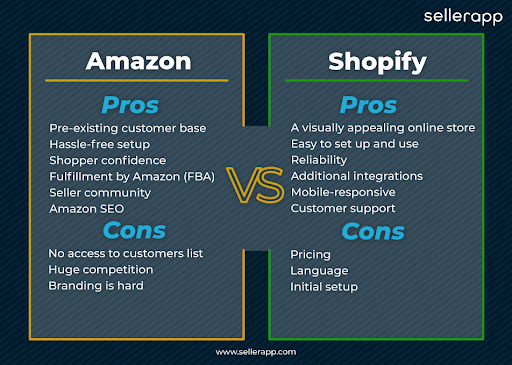
Choosing between Shopify and Amazon can be tough. Both platforms have their own strengths and weaknesses. Understanding the pros and cons can help you decide which is better for your business needs.
Shopify Advantages And Disadvantages
Shopify offers a user-friendly interface. It is easy to set up and customize. You have full control over your online store. You can design it to fit your brand. This platform supports multiple payment methods, making transactions smooth.
Shopify also has excellent customer support. It is available 24/7 through chat, email, or phone. You get access to a wide range of apps. These can help you manage your store better. The platform also supports SEO, which can boost your search engine ranking.
However, Shopify has some drawbacks. It comes with monthly fees. These can add up, especially for new businesses. Some apps also have additional costs. You may need to pay for themes to make your store look unique. If you lack technical skills, customization might be difficult.
Amazon Strengths And Weaknesses
Amazon has a massive customer base. Millions of people visit the site daily. This gives your products high visibility. You can tap into this traffic without doing much marketing. Amazon handles shipping and returns. This saves you time and effort.
The platform also provides a trusted shopping experience. Customers feel safe buying from Amazon. You can start selling quickly. There is no need to build a website from scratch.
But Amazon has its downsides. It charges high fees. You pay for each sale and other services. The competition is tough. Many sellers offer similar products. This can make it hard to stand out. You also have less control over your store. Amazon sets many of the rules.
The branding opportunities are limited. Customers may not remember your business name. They might only remember Amazon.
Frequently Asked Questions
What Are Shopify And Amazon?
Shopify is an e-commerce platform for creating online stores. Amazon is a massive online marketplace where businesses can sell products.
How Does Shopify Differ From Amazon?
Shopify offers customizable online store creation. Amazon allows selling on its existing platform with huge traffic but less control.
Which Is Better For Small Businesses, Shopify Or Amazon?
Shopify is better for branding and customization. Amazon is better for reaching a larger audience quickly.
Can You Use Shopify And Amazon Together?
Yes, many businesses use Shopify for their own store and Amazon to reach more customers.
Conclusion
Choosing between Shopify and Amazon depends on your business needs. Shopify offers customization and control. It’s great for building your own brand. Amazon provides a vast audience and ease of use. Ideal for quick sales. Both have their strengths and weaknesses.
Consider your goals, budget, and preferences. Each platform can support your e-commerce success. Understand what you need. Make an informed choice. Happy selling!
